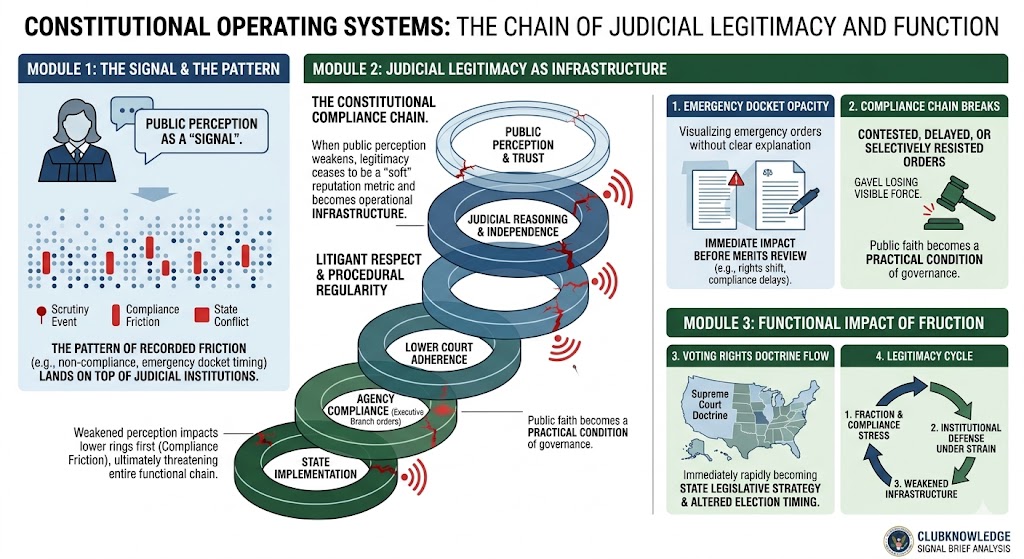
A detailed infographic titled "Constitutional Operating Systems: The Chain of Judicial Legitimacy and Function." The visual is divided into three modules. Module 1 shows a judicial figure and a data plot representing public perception as a "signal" of institutional friction. Module 2 features a central 3D "Constitutional Compliance Chain" composed of interlocking rings: Public Perception, Judicial Reasoning, Lower Court Adherence, Agency Compliance, and State Implementation. Cracks and red "friction" signals appear on the rings, indicating how weakened trust impacts the entire functional chain. Module 3 highlights the practical impacts of this friction, including "Emergency Docket Opacity," a "Voting Rights Doctrine Flow" map of the U.S., and a "Legitimacy Cycle" diagram showing how institutional defense responds to compliance stress. The bottom right corner features the "ClubKnowledge Signal Brief Analysis" logo.
Courts and Rule of Law, Judicial Independence

Roberts Defends Supreme Court Neutrality as Legitimacy Becomes a Legal Signal

Chief Justice John Roberts says Supreme Court justices should not be treated as political actors. The record does not prove partisan motive. It does show why public confidence, emergency orders, compliance fights, and judicial pressure now belong in the same legal-environment file.