How Motion, Memory, and Heredity May Have Met
Life exists in a universe of continual motion. The planet turns, water circulates, air moves, minerals fracture and dissolve, molecules diffuse through liquids and gases, and heat flows from warmer regions toward cooler ones. Long before there were cells, genes, nervous systems, or organisms capable of remembering anything, matter was already being transported through changing environments. The early Earth was especially dynamic: oceans and ponds formed and disappeared, water evaporated and returned, ice froze and thawed, minerals interacted with gases and liquids, radiation altered molecules, and geothermal energy continually rearranged local chemical conditions.
Motance begins with a deceptively simple question: what could all of that motion actually have done?
The question is not whether motion somehow created life. Motion by itself explains very little because motion exists everywhere. Molecules vibrate, collide, rotate, and diffuse in every ordinary chemical environment. A useful scientific explanation therefore has to identify something more specific: the kinds of transport, cycling, concentration, separation, and energy flow that altered chemical possibilities under particular physical constraints.
Flow, for example, can replenish reactants in one environment while washing useful products away in another. Evaporation can concentrate compounds enough for reactions to occur, yet repeated exposure to water may later destroy some of the products. Mineral surfaces can bring molecules together, catalyze reactions, protect fragile compounds, accelerate their degradation, or bind them so strongly that they become chemically useless. Heat can accelerate both construction and destruction. Radiation can supply energy for new chemistry while simultaneously breaking molecules apart.
This is why Motance gradually moved away from the broad idea that motion itself is constructive. The more defensible proposition is that motion and energy flux create opportunities for interaction, while physical constraints determine which interactions become probable, local, repeated, or persistent. A molecule diffusing through an open ocean does not encounter the same conditions as one held within a microscopic mineral pore. Chemistry inside a droplet differs from chemistry dispersed through bulk water. Boundaries alter exchange, interfaces alter reaction probabilities, and cycles determine the order in which different conditions occur.
The important relationship is therefore not simply motion leading toward life. It is motion acting through constraint, producing interactions whose consequences may sometimes survive the conditions that created them.
That last possibility leads to the central idea behind Motance: memory.
In ordinary language, memory implies a mind. Motance uses the term more narrowly and physically. Imagine that a chemical environment changes and later returns exactly to its earlier condition, leaving nothing behind that affects subsequent events. Something happened, but nothing of consequence was retained. Now imagine instead that heating alters a molecule and the altered structure remains after cooling, or that a drying cycle joins molecules into a product that survives when water returns, or that a chemical event changes the composition of a droplet so that the droplet behaves differently during the next cycle. The past has now left a state capable of influencing the future.
Persistence alone, however, is not sufficient. A crater records an impact and a sediment layer records an earlier environment, but neither necessarily functions as memory in the Motance sense. For a persistent state to become functional memory, something later must physically respond differently because that state exists. A molecular sequence may alter binding, a folded structure may alter catalysis, or a retained chemical composition may alter the behavior of a compartment. The past is no longer merely preserved for an observer to reconstruct. It has become causally active within the system itself.
Motance therefore defines memory as a persistent, history-dependent state that can be physically read and thereby changes later dynamics. The reader need not be conscious. It can simply be another physical process. Complementary nucleic acids can respond to sequence through base pairing, catalysts can distinguish molecular structures, and membranes or droplets can respond differently to particular molecules contained within them. What matters is that changing or destroying the retained state changes what happens afterward.
This distinction between a record and functional memory is one of the framework’s most important boundaries. Matter has recorded its history since long before life existed. The harder transition is the emergence of states whose history becomes useful to the system carrying them.
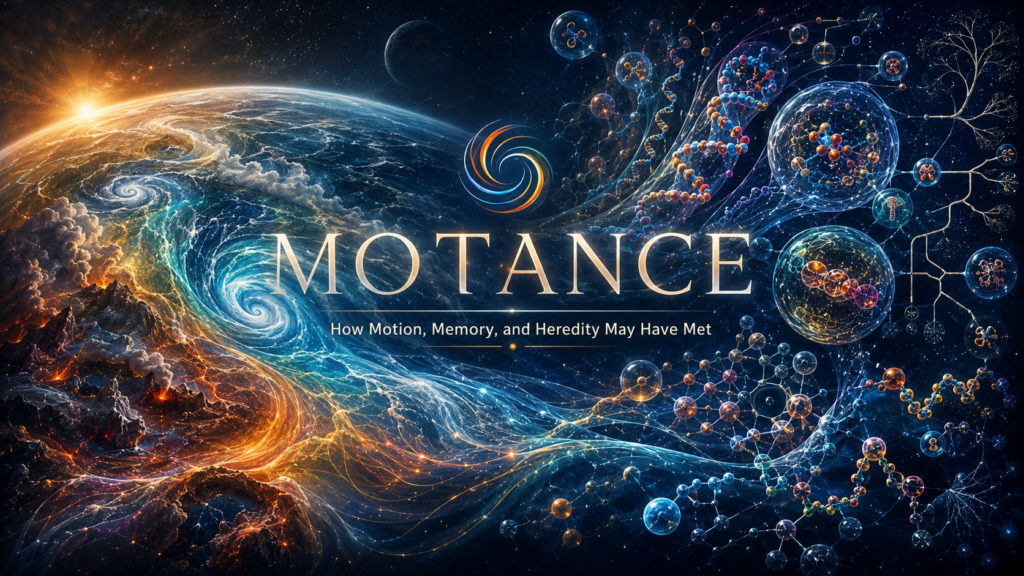
Here is the complete scientific framework and current research model for Motance.